We’ve all seen this in Slack or Teams or iMessage, right?
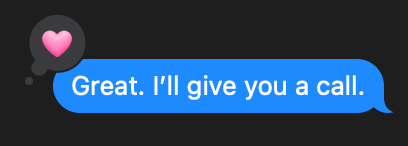
An unnecessary heart Tapback. This is a colleague ❤️ing a text about some follow-up after a sales call.
A ❤️ means love, right? You ❤️ your spouse when their plane is about to take off. You ❤️ a cute photo of your kids or a dog playing in the snow. You can even ❤️ sad things because your ❤️ goes out to eulogies or cancers.
But these ❤️s are being used instead of a thumbs up, which is confirming that something is true, or that someone agrees to a statement or question or request. You don’t love when someone answers a true or false questions about a software feature you’re developing for patient monitoring. If you did, that ❤️ is close to an HR violation!
This reminds me a bit of the premature honey from Curb, where Richard calls his new girlfriend honey weeks after they’ve started dating, and she nearly walks because the implication is that he is high maintenance or overly attached.
While I love the rapid evolution of visual and text-based language, I think some restraint is important, otherwise, if we’re ❤️ing that we received emails or ❤️ing that a meeting has started and a colleague is running later, what do we do when we actually want to ❤️ something with emotional resonance?
 Diminishing Returns